
Dehumidification Control: Solving the DX and Electric Heater "Tug-of-War"
Primary Engineering Directive
Before exploring the field logic below, it must be explicitly stated: It is highly recommended to use dedicated, industrial-grade HVAC DDC (Direct Digital Control) systems or PLCs for scenarios involving simultaneous heating and cooling. Devices like the SHT2000 are basic ( on shelf ) components not didcated to this type of scenarios . True critical facility management demands calibrated, commercial-grade controllers (e.g., Honeywell, Siemens, Danfoss, or equivalent) designed specifically to handle staging, protective deadbands, and active reheat safely.
The Scenario: You are managing a large Air Handling Unit (e.g., a 60-ton DX system with 40 kW of electric heating) serving a space that requires strict temperature and humidity control (around 50% RH). The unit relies on basic return-air temperature control, but you find the space is severely over-drying (dropping to 35% RH), or the equipment is violently fighting itself. Here is the engineering breakdown of why this happens and how to design a deterministic control interlock to fix it.
1. The Core Problem: The Psychrometric Flaw
A common mistake in facility management is attempting to raise relative humidity (RH) by turning on electric heaters when the space gets dry. Heaters add sensible heat; they do not add moisture. Raising the dry-bulb temperature of the air without adding water vapor mathematically lowers the relative humidity.
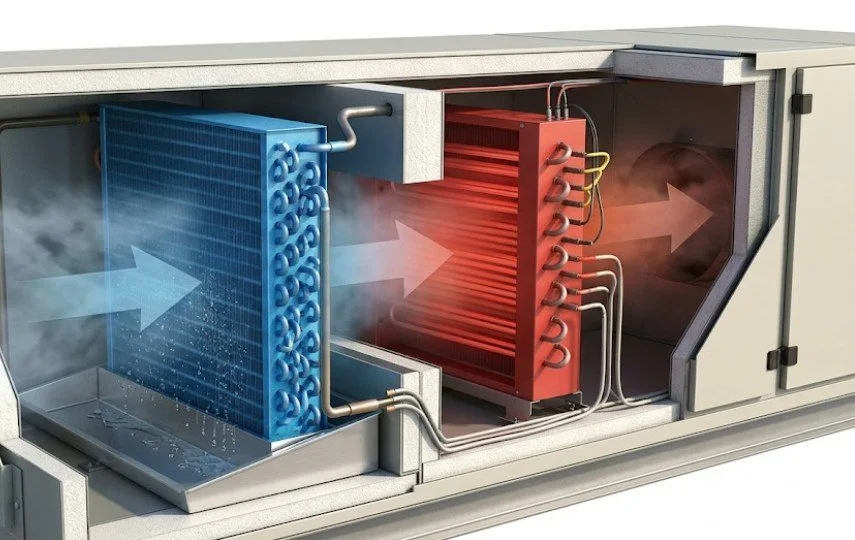
Furthermore, running 40 kW of heaters constantly forces the 60-ton cooling coil to work overtime just to satisfy the space thermostat. This drives the cooling coil temperature well below the dew point, wringing all the moisture out of the air. You accidentally create a massive, continuous dehumidification cycle.
The Dangers of Basic "Bang-Bang" Controllers
When attempting an emergency field fix using cheap, single-relay incubator controllers, engineers often make critical errors:
- The Sensor Placement Trap: Never place temperature sensors in the supply duct. The rapid temperature changes from DX cooling and electric reheat will cause rapid short-cycling, destroying high-capacity compressors in hours.
- Multiple Sensor Chaos: Placing four uncalibrated, low-budget sensors in a return duct guarantees they will fight each other. Stages will fire out of sequence.
- The Reheat Myth: Programming a controller to "turn on heaters if RH is high (>60%)" does not remove water. Without the cooling coil running, you simply create a hot, sticky room.
2. The Emergency Field Interlock
If you are strictly limited to basic on-shelf controllers for an immediate, temporary field fix, you must use electrical interlocking to mimic commercial staging safely until proper industrial controllers can be procured.
- One Master Sensor: Place a single temperature/humidity sensor in the return duct to act as the master for the base load.
- The Dehumidification Interlock: To remove moisture, the cooling coil must run. Wire the humidity relay to an auxiliary DPDT relay. When RH exceeds 55%, this aux relay must simultaneously Turn ON the heaters AND force the base cooling compressors ON. The cooling coil strips the water, and the heaters reheat the 12°C air back to room temperature.
- Anti-Short Cycle Timers: You must hardwire physical delay-on-make timers (3 to 5 minutes) in series with the compressor contactors to prevent motor burnout when the humidity relay chatters.
3. Interactive AHU Interlock Simulator
To visualize exactly how this electrical interlock translates to psychrometric performance, use our interactive tool below. Adjust the Return Air constraints to observe how the auxiliary relay forces the equipment to collaborate rather than fight.
AHU Dehumidification Interlock Simulator
Below is an interactive simulation based exactly on the control architecture designed above. You can adjust the Return Air Temperature and the Return Air Humidity to see how the sensors, the auxiliary interlock relay, and the heavy equipment respond in real-time.
How to use the Simulator:
- Standard Cooling: Raise the temperature above 23°C while keeping humidity low. You will see the base compressors turn on normally.
- The Interlock (Active Dehumidification): Drop the temperature to 21°C (no cooling required for temp) but raise the humidity above 55%. Watch how the Aux Relay fires, turning on the heaters and simultaneously forcing Compressors 1 & 2 on to wring out the moisture.
- Peak Load: Push the temperature above 25°C to see the second stage of cooling kick in to assist.
(≥ 23°C)
(ON ≥ 55%, OFF ≤ 45%)
(Triggered by Humidity)
Circuits 1 & 2 (30 Tons)
Circuits 3 & 4 (30 Tons)
(40 kW Reheat)
Conclusion
Control logic is simply an electrical representation of our psychrometric requirements. By ensuring that your heating and cooling systems are intentionally interlocked to handle latent loads, you protect your critical equipment from premature mechanical failure while maintaining strict space parameters.
