
CED Technical Academy: Engineering Masterclasses
Standard theoretical education often fails when confronted with field reality. CED Engineering provides rigorous, industry-recognized technical training led directly by our Principal Engineer.
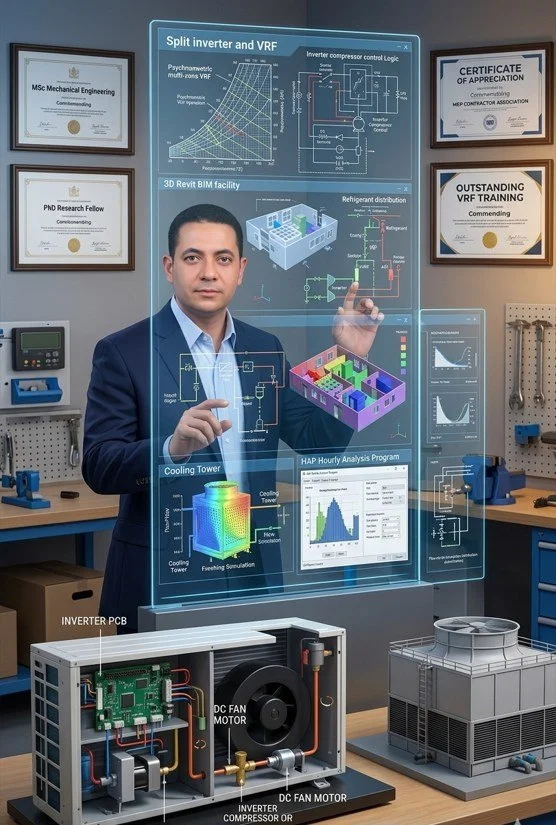
As an active PhD Researcher with an MSc in Mechanical Engineering, our founder possesses the unique academic rigor required to break down highly complex thermodynamic theories and translate them into clear, actionable logic. Backed by formal commendations and certificates of appreciation from corporate partners, our masterclasses bridge the gap between elite academic theory and hands-on commissioning.
We train practicing engineering teams, MEP contractors, and facility managers to understand not just the 'how,' but the deep-level 'why' behind advanced mechanical systems.
Unlock Course Access
Test your knowledge and get immediate access to the free course.
Precision Load Analysis & Spatial Modeling
Focus: Hourly Analysis Program (HAP) & Advanced AutoCAD MEP.
Description: Move beyond basic drafting. This module trains engineers to execute highly accurate thermal load calculations and translate those metrics into precise, clash-free AutoCAD spatial layouts. We teach the rigorous standards required for industrial and commercial compliance.
Heavy Thermal Systems & Plant Engineering
Focus: Applied HVAC & Industrial Cooling Towers.
Description: A deep dive into the operational mechanics of large-scale thermal management. Trainees learn the critical thermodynamics, psychrometrics, and fluid dynamics required to design, select, and troubleshoot high-capacity cooling towers and heavy HVAC plant equipment.
Hydronic Systems & Chilled Water Plant Engineering
Focus: Applied Chilled Water Systems & Hydronic Balancing.
Description: Move beyond basic pipe sizing. This masterclass focuses on the physical realities and critical oversights of hydronic plant engineering. We bridge the gap between theoretical schematics and field commissioning, covering primary/secondary pumping logic, precise decoupler sizing, expansion tank pressure calibration, and the strict integration of pressure safety relief valves to ensure long-term, fail-safe operations.
Field Application Scenario: The High-Ambient VFD Failure
The Situation: It is mid-summer in a Southern Iraq industrial facility. Ambient temperatures have reached 52°C. A 100-ton air-cooled condenser unit repeatedly trips on high discharge pressure alarms. The local maintenance team assumes the compressors are failing under the extreme heat load and recommends a costly replacement.
The CED Diagnostic Approach: In our masterclass, we teach engineers to stop guessing and start tracing the logic. Our trainees learn to bypass the mechanical assumption and immediately evaluate the analog control loop.
Upon inspection, the team discovers that the 4-20mA pressure transducer on the discharge line has a corroded terminal. It is sending a flat 4mA "zero pressure" signal back to the main PCB. Because the Variable Frequency Drive (VFD) thinks the system pressure is low, it commands the condenser fans to run at their absolute minimum speed (20Hz) while the compressors are fighting a massive heat load.
The Result: Instead of replacing a $15,000 compressor, the technician replaces a $50 sensor wire and restores full VFD modulation to the fans.
This is the exact caliber of diagnostic troubleshooting we drill into your engineering teams. We do not just teach them how the system should work; we teach them exactly how it fails in the field.
Move the temperature bar below , see the condenser fan rotation
DX Condenser VFD Logic Simulator
Adjust ambient temperature to observe inverter fan modulation.
Fan Motor Speed: 70%
VFD Control Signal Modulating