
Chilled Water Pump Installation: Roof vs. Ground Floor Retrofit
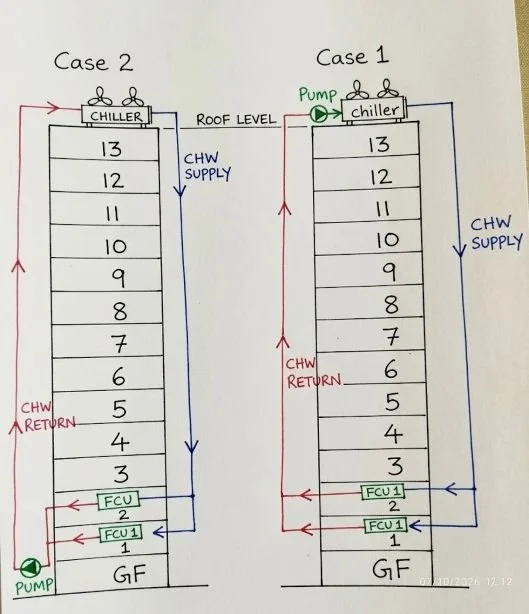
schematic of a 13 floor building with chilled water system , Pump installed on roof and GF
🚀 CED ENGINEERING | FIELD RETROFITS
Real-World Hydraulics: When a Textbook "Flaw" Is the Right Engineering Decision
We recently faced a classic HVAC challenge in a premium 15-story residential building. Residents on the top floor were experiencing severe, continuous structural vibrations and low-frequency noise coming from the roof. The source? A pair of high-speed (2900 RPM) chilled water pumps serving corporate offices on the 1st and 2nd floors. The pumps were anchored directly to an uninsulated steel structure, which acted like a massive tuning fork, propagating mechanical energy straight down through the concrete roof slab.
The standard textbook response? Fabricate a massive concrete inertia base on the roof, isolate it with heavy-duty open spring mounts, and realign the system. However, the residents strictly opposed any further noise or prolonged structural modifications on the rooftop. Faced with limited workspace and constraints above, we executed an aggressive field retrofit: We relocated the pumps entirely to the ground floor garage, anchoring them directly onto a solid concrete slab. The results have been exceptional.
🎯 Hydraulic Analysis & Engineering Trade-offs:
From a strict fluid mechanics perspective, design catalogs would flag this as "inefficient." By dropping the pumps to the ground floor, the chilled water loop must drop from the 1st floor down to the garage, pass through the pump casing, and travel back up to the roof chiller before descending again. This extra pipe length and additional 90° elbows permanently increased dynamic friction losses, shifting the pump's operating point on the system curve.
However, true facility engineering requires evaluating the entire building ecosystem rather than analyzing an isolated component curve. Here is the engineering breakdown of the resulting parameters:
1️⃣ Structural Vibration & Acoustics
The original rooftop steel mount directly injected kinetic energy into residential zones. Relocating the equipment to the solid foundation of the ground floor garage decoupled the vibration source entirely, reducing structural acoustic transmission down to 0%.
2️⃣ Cavitation & Suction Head Optimization
On the roof, pump suction occurred at the lowest pressure point of the system (close to the HGL), risking air binding and impeller erosion. At the ground level, the pump operates under a massive 15-story static water column, guaranteeing an exceptional net positive suction head (NPSH) and eliminating cavitation risks entirely.
3️⃣ Maintenance Accessibility & Safety
Moving heavy servicing tools up tight roof structures under extreme outdoor ambient temperatures exposed technicians to unnecessary risks. The ground floor garage provides a flat, secure, sheltered environment that dramatically decreases Mean Time to Repair (MTTR).
4️⃣ Power Consumption & Motor Thermal Load
The added vertical pipe runs increased the loop's overall dynamic resistance. This shifted the hydraulic operating point, causing the motor to draw slightly more electrical current. However, this marginal power increase remains safely within the motor's full-load amp (FLA) threshold and nominal safety factors.
💡 The Operational Verdict:
By accepting a minor, predictable increase in piping friction, we completely wiped out tenant vibration complaints, permanently protected the pump impellers from cavitation erosion, and provided our maintenance crew with a safe, accessible working environment.
The Takeaway: Engineering isn't simply about chasing theoretical efficiency percentages on a catalog sheet. True facility engineering is the art of balancing fluid dynamics with human comfort, structural reality, technician safety, and real-world project constraints.
