
Managing the Flow: Inside the Primary-Secondary Injection Loop & Buffer Tank Optimization
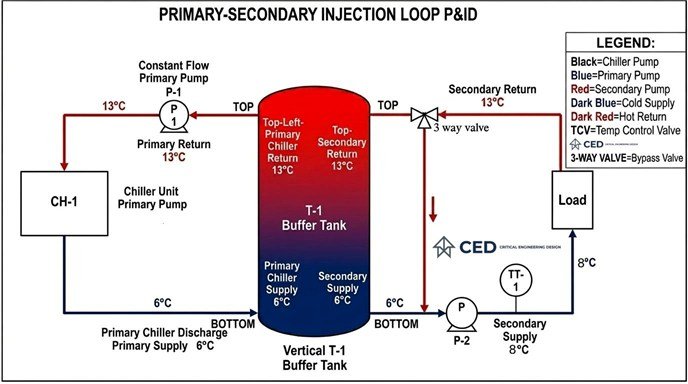
Interactive Simulation
Primary-Secondary Injection Loop Simulator
🥤 The Simple Concept: "Mixing the Perfect Drink"
Imagine you have a 🥤 cup of water that is too warm (13°C). You have a fridge providing ice-cold water (6°C). To get your 🥤 drink to the perfect temperature (8°C), you don't throw the whole drink away; you just inject a little bit of cold water into it until it’s just right.
🏢 1. The Three Main Players
- The Chiller (CH-1): The "Cold Factory." It takes warm 13°C water and cools it down to a steady 6°C.
- The Buffer Tank (T-1): The "Thermal Battery." It holds a large volume of water to act as a shock absorber so the chiller doesn't have to turn on and off constantly.
- The Load: Your "Building/Machines." They create heat, turning your nice 8°C supply water back into 13°C return water.
⚙️ How it Operates (Step-by-Step)
The Chiller Pump (P-1) moves water in a simple circle: Chiller → Buffer Tank → back to Chiller. This keeps the bottom of the tank at a very cold 6°C.
The Secondary Pump (P-2) pulls water from the tank to send it to the machines (Load).
Look at the 3-way valve in your drawing. It sits on the return line (13°C).
- Most of the water simply loops back to the tank.
- However, if the machines need more cooling, the valve "injects" some of that 13°C water into the cold supply line.
By mixing the 6°C water from the tank with some 13°C return water, the system creates exactly the 8°C supply seen in your diagram.
🧠 The Control Logic
The "Brain" of this operation is the TT-1 (Temperature Transmitter).
- 🔴 If TT-1 reads 9°C (Too Hot): It tells the 3-way valve to close the bypass and pull more 6°C water from the bottom of the tank.
- 🔵 If TT-1 reads 7°C (Too Cold): It tells the 3-way valve to open the bypass, mixing in more warm return water so we don't waste energy over-cooling.
💡 Why use this "Injection" style?
It separates the Chiller Flow from the Building Flow. This means the chiller can run at its own steady speed while the building pumps can ramp up or down without causing a "pressure war" between the pumps.
